David Hockney shaped modern art like few others did since the 1960s. His bold colors catch eyes instantly, yet it is how he bends space that makes you pause. Instead of sticking to one way of seeing, he shifts angles as if walking around a room mid-painting.
Paintbrushes gave way to tablets without hesitation—screens became canvases just as real. Swimming pools in Los Angeles appear again and again, still glowing under flat suns. Time passes, but his curiosity never flattens out. What began with oils now flows through pixels, yet feels equally alive.
A closer look at this artist traces his journey through years of change, creative growth, key pieces that stand out, how he worked, yet what still shapes art today.

A portrait of David Hockney, Image Source: Floren
Early Years and How Art Took Shape
On July 9, 1937, a boy entered the world in Bradford, part of Yorkshire, England—his name would become David Hockney. Childhood unfolded amid modest means, yet drawings filled his days from an early age. Encouragement came not by chance but through training at the art school in his hometown. After that, learning continued under stricter walls—the Royal College of Art in London.

A photo of the Royal College of Art, Image Source: Royal College of Art
Hockney stood out at the Royal College by painting without rules. Right away, figures leapt from canvas drenched in bright hues and sharp edges. Instead of copying Picasso or Matisse, he used their energy like fuel for something new. The old painters mattered too—not as ghosts to follow, but sparks that lit his way. Boldness wasn’t planned; it just showed up in every stroke.
Hockney found attention by age twenty-five, then showed alone at London's Kasmin Gallery in 1967. Overseas displays followed without delay, placing him among key voices in Britain’s new wave of art makers.
Themes and Art Styles
David Hockney’s art is characterized by several enduring themes:
1. Light, Color, and Space
Out under the glare of a pool's shimmer, light bends just right in Hockney’s hands. Bright swaths of paint sit still but hum with energy. Warm reds push against icy blues, tension held tight across the canvas. Across fields of green that roll slow into distance, shade shifts like breath. Color doesn’t blend—it argues, then sings. Each stroke lands flat yet feels deep. Mood builds not in detail, but in how yellow meets gray at an edge. Even quiet landscapes vibrate, charged by choice, never accident.
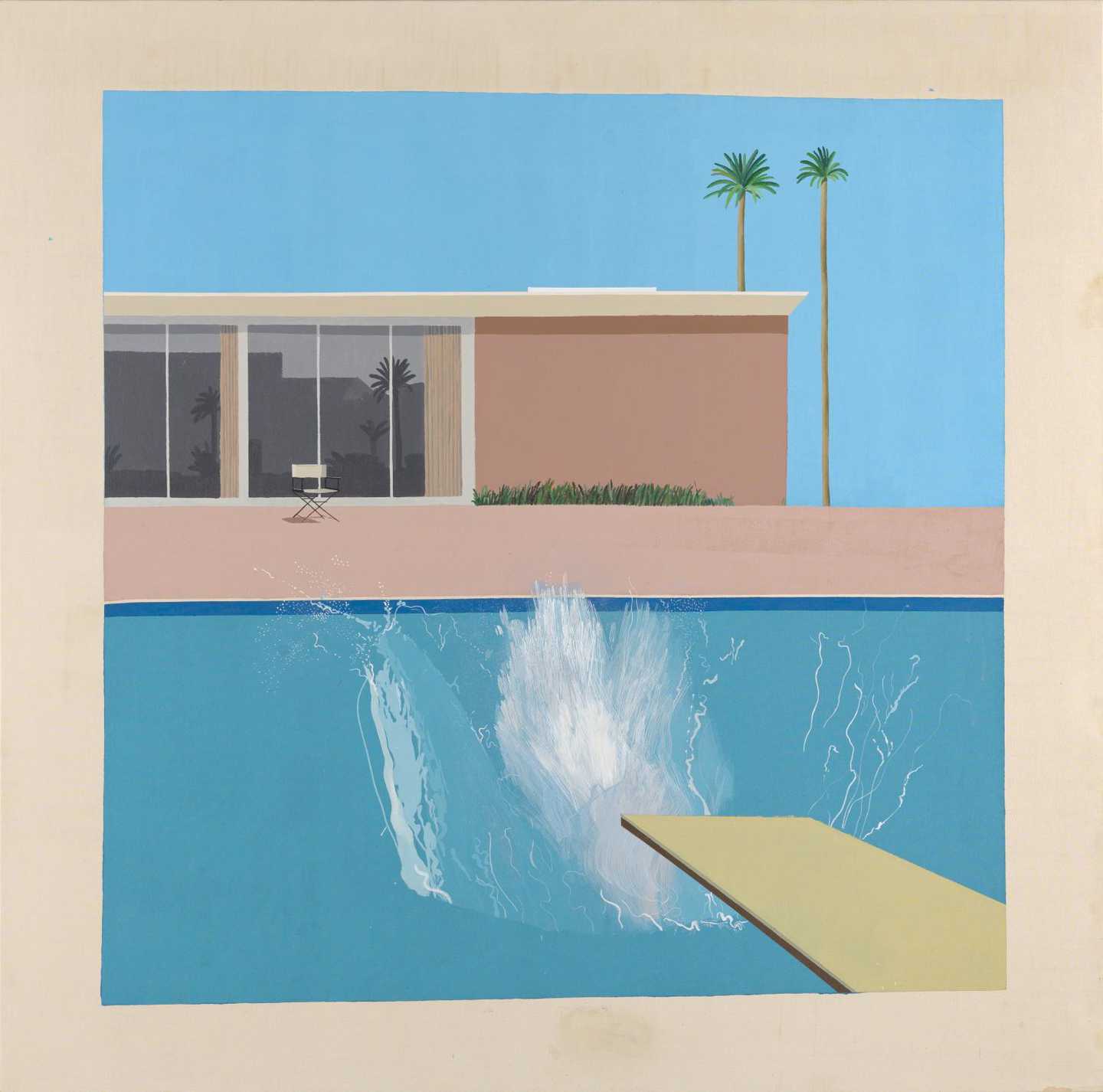
David Hockney's "A Bigger Splash" (1967) close up, Image Source: Tate
2. Perspective and Perception
Looking at space has always pulled Hockney in. Because of studying Cubism and old Renaissance pieces, he often uses flipped angles alongside shifting standpoints. Instead of sticking to straight-on views, his images let eyes wander freely through layered scenes. Seeing depth becomes looser when flatness meets overlap in surprising ways.
3. Everyday Life as Subject
Hockney peers into quiet corners instead of big tales—friends linger by windows, rooms breathe slowly under painted light. His eye lands on what feels close, familiar, yet somehow remade. These choices carry intimacy, yes, but also something wider, shared without saying so. What he sees sticks because it already lives somewhere inside us.
Works That Shaped a Legacy
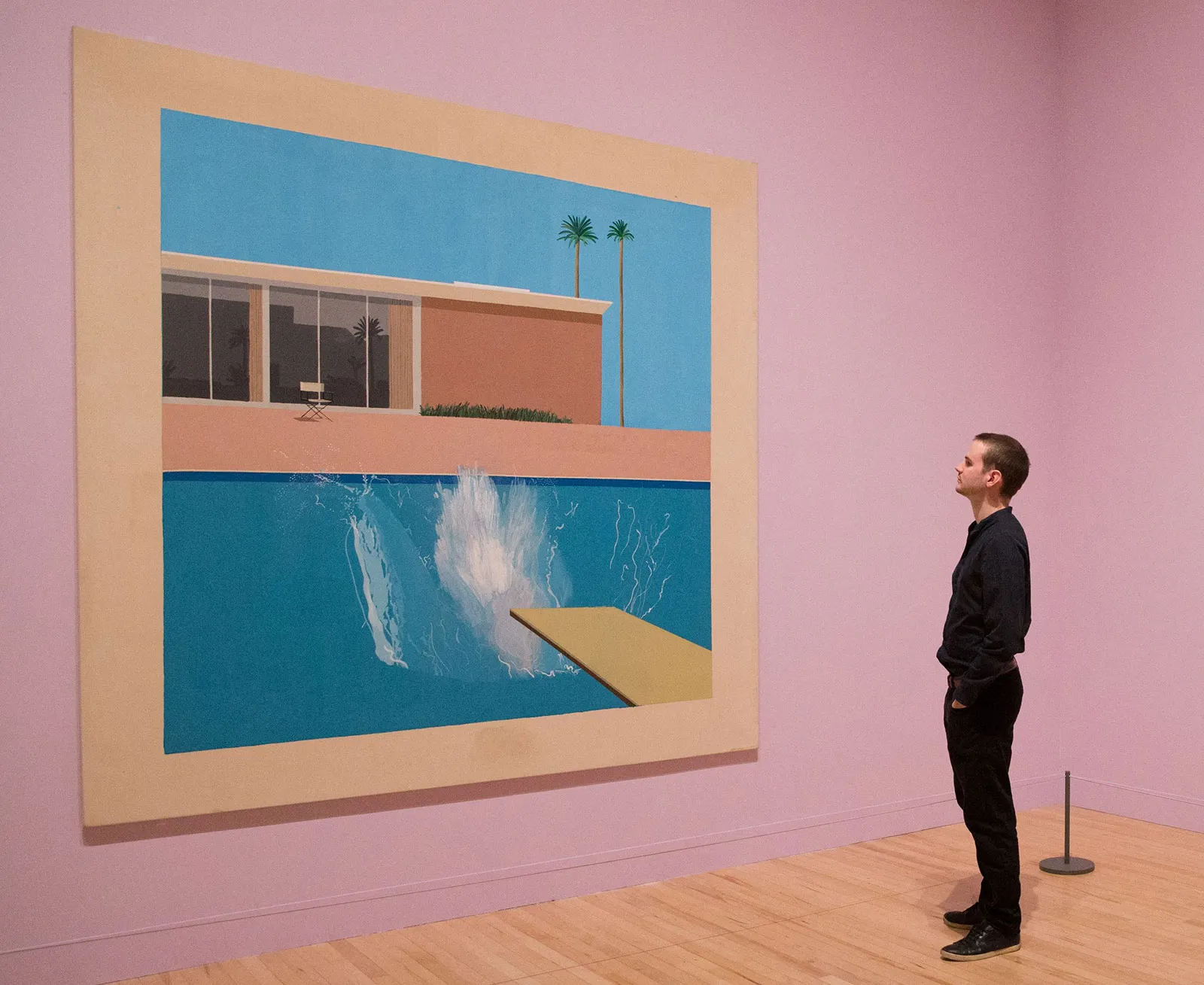
A Bigger Splash (1967): One of Hockney's best-known works, it freezes the split second after a dive—water mid-splash above a still, bright pool under the California sun. This scene holds the shiny hope of 1960s LA, quiet yet full of motion.
Beverly Hills Housewife (1967): Inside, Betty Freeman sits surrounded by greenery spilling through her L.A. living room. Painted big, in acrylic, it captures more than a moment—a play on depth that feels close yet stretched.

Beverly Hills Housewife, 1967, Image Source: Singulart
A Bigger Grand Canyon (1998): A single massive project, made up of sixty painted panels, captures the Grand Canyon in bold, vivid hues. From many angles at once, the scene unfolds like fractured glimpses pieced together.
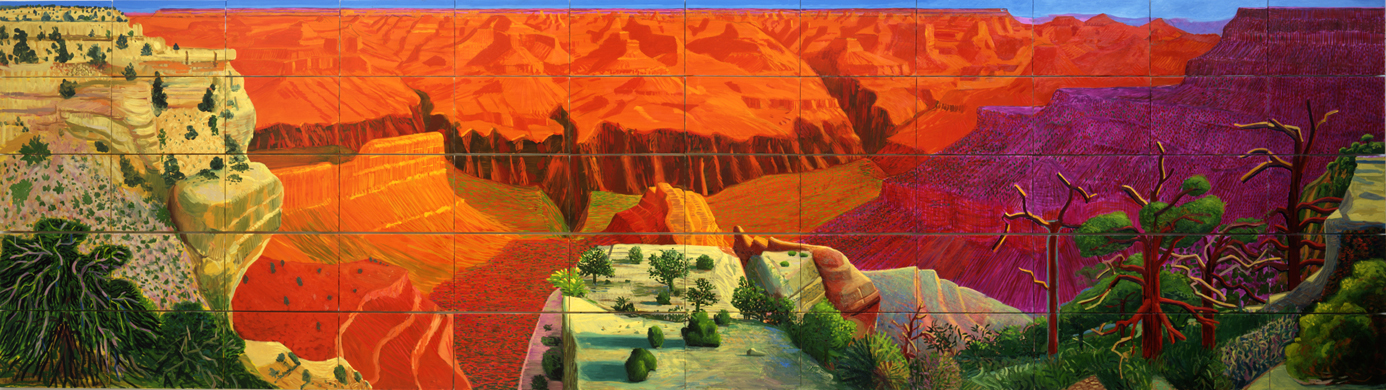
A Bigger Grand Canyon, 1998, Image Source: The David Hockney Foundation
Garrowby Hill (1998): Back in Yorkshire, where he began, Hockney painted landscapes alive with bold strokes and shifting ground. The curves of the Wolds unfold—clear yet full of motion.
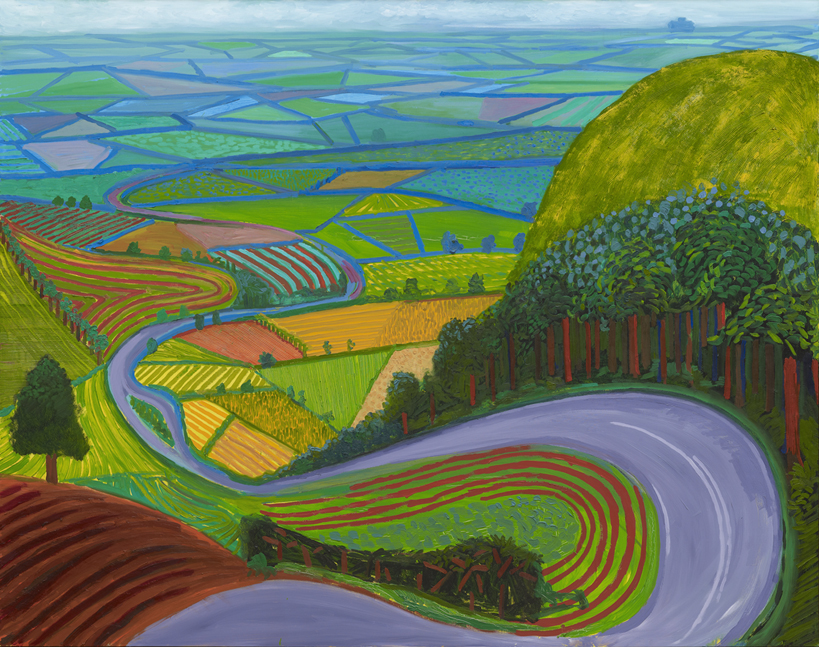
Garrowby Hill, 1998, Image Source: The David Hockney Foundation
Innovation Across Mediums
Far from still, Hockney's drive to explore pushes past old forms of paint on canvas.
Photocollages and “Joiners”
In the eighties, Hockney started making "joiners"—images built from many small photos stuck together. These pieces show how he liked seeing things from more than one angle at once, capturing different seconds stitched into one view. It brings to mind Cubism, only done his own way.

Unfinished Painting in Finished Photograph(s) April 2nd 1982, Image Source: The David Hockney Foundation
Digital Art and iPad Drawings
Back when pixels weren’t common in galleries, Hockney dove into tech. Fax gadgets caught his eye first; eventually, tablets and virtual paint took over. Bright yellows, deep blues—his palette stayed true even as screens replaced canvas.

Photo by Ahmed u061c on Pexels.com
Stage Design and Mixed Media
Painting sets for operas like The Magic Flute gave Hockney a chance to blend images with live action. Because of jobs like these, his range in art became clearer over time.
Recognition, Exhibitions, and Legacy
David Hockney's path unfolded across decades, earning praise far beyond borders. Over four hundred one-artist displays carried his name into galleries everywhere. Big museums paused to look back at what he made—places such as Tate Britain, New York’s Met, and LACMA.
Beginning in 2025, the Fondation Louis Vuitton hosted David Hockney 25, drawing together more of his art than ever before. Works on view reached back to 1955, forward into that very year—paintings, digital pieces, and moving images.
Back in 1997, Hockney became a Companion of Honour. Since then, prizes have followed because of what he's brought to painting. Prices for his work stay strong, showing people want it and critics respect it.
Effect on Modern Art
Color leaps out in Hockney's pieces like a shout in a quiet room. Because of him, younger painters see space differently—tilted, stretched, alive. New tools arrive, yet his touch stays human, never lost in machine glow.
What stands out is how he shaped the British Pop art scene without copying ads or trends. Instead, life around him—places, people, routines—became bold, filtered through his own intense perspective. Vision like that changed the way others saw ordinary things.
David Hockney Still Matters
What stands out about David Hockney is less the volume of his art and more how he keeps reshaping who he is without losing sight of what matters to him. Leaping across styles—British roots, sunlit California scenes, fractured Cubist forms, pixel-heavy screens—he pulls off a rare feat: feeling old and new at once. Right now, plenty of creators wrestle with machines and self-image. Yet Hockney moves through it all with openness. Look at his work and something shifts inside you—suddenly it's not about staring, but noticing.
Conclusion
A splash of blue might catch your eye first, yet David Hockney offers far more than paint on canvas. Moving through time, his vision stretched past traditional frames into new forms. A Bigger Splash draws you in, but it was only one step in a longer journey.
Light dances differently because he studied its steps so closely. Color feels bolder now, shaped by choices others feared to make. Landscapes breathe again, thanks to his quiet attention. The art world shifts slowly, yet his mark stays clear. His hand is never still, always drawing something new into existence.