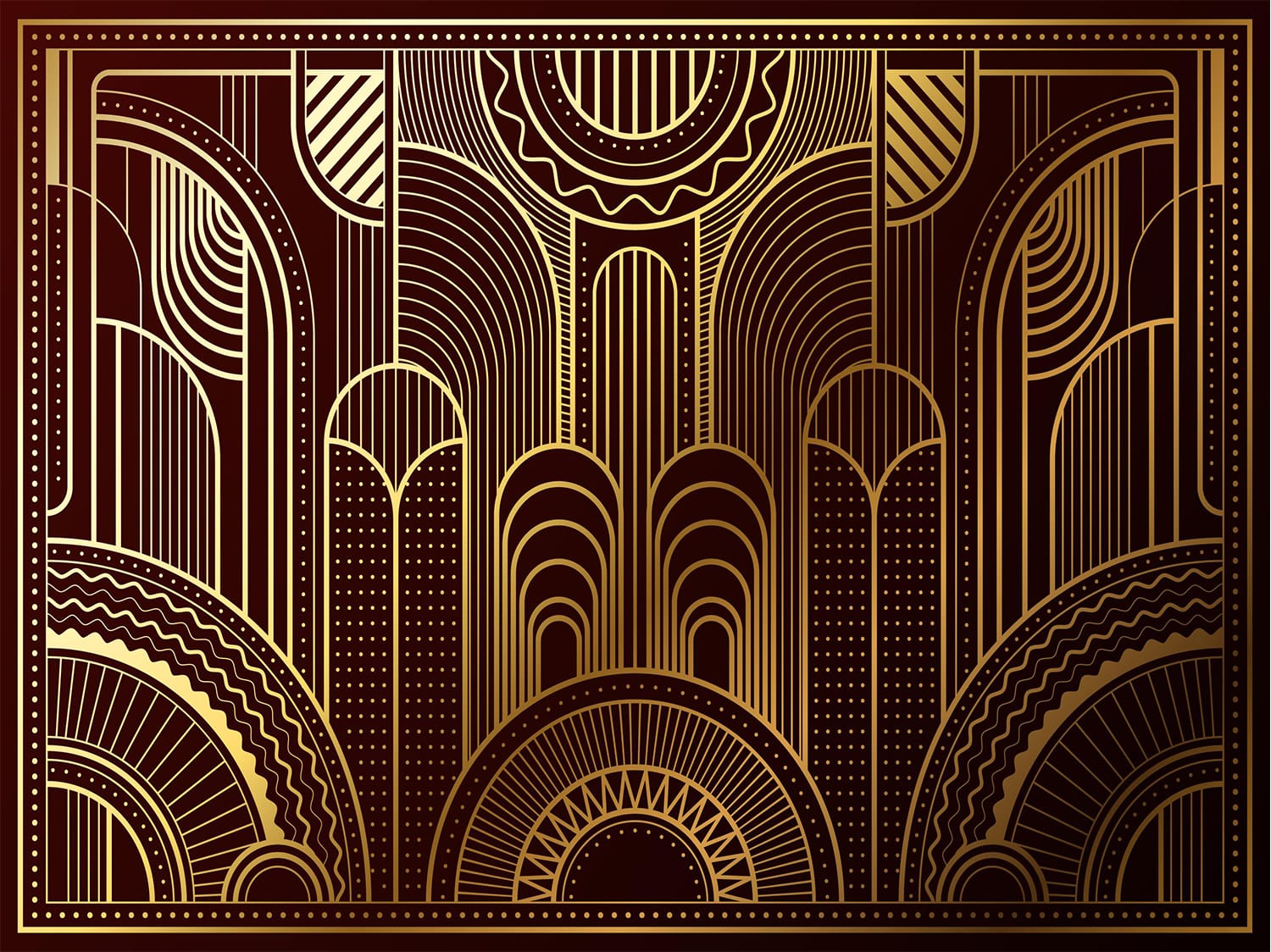
Shiny shapes cut through time - this style grabbed attention fast. With sharp lines meeting rich textures, it whispered speed, luxury, newness. Not just buildings or paintings but clothes, rooms, posters too began wearing its mark. A hundred years on, echoes still show up where we least expect them. Style like this doesn’t fade; it shifts into fresh forms quietly.
What makes Art Deco tick? We dig into its roots, how it looked, who shaped it. Think bold lines, sharp geometry, a splash of luxury. Artists like Tamara de Lempicka brought edge and glamour. The style bled into painting, sculpture, architecture. Even now, decades later, echoes show up in design, fashion, cityscapes. Time hasn’t dulled its presence.

Indigo Palm Wallpaper from Art Deco
What is Art Deco?
Art Deco began in the 1910s, growing into a bold visual movement through the next two decades. Though it touched many forms of design, its heart was in striking aesthetics. A major Paris exhibition in 1925 gave it an official platform - this event shaped how people saw modern decoration. That gathering, focused on modern industrial and decorative arts, became the source of the term itself. By then, sharp lines and rich materials already defined its look across buildings and objects.
Art Deco is defined by its embrace of:
Geometric forms
Symmetry and order
Rich colors and luxurious materials
Themes of speed, technology, and modern life
Fueled by speed, sleek forms, and electric light, Art Deco turned gears and skyscrapers into beauty. Instead of forests or ancient battles, it found inspiration in factories, trains, and tomorrow's dreams.
The Story Behind Art Deco and Its Times
After World War I, people looked ahead with hope. Out of ruin rose Art Deco, shaped by fresh thinking instead of old ways. Life began embracing speed, lightness, bold shapes. Materials like chrome and glass stood in place of wood and stone. Progress felt visible through sharp angles, clean surfaces. A mood of renewal drove how things were designed back then.
Fueled by optimism, Art Deco reflected faith in advancement. Wealth and self-assurance shaped its bold forms. Progress wasn’t just hoped for - it showed up in every line, in every shape. People trusted the future, then built it into their designs.
Machines began shaping everything. Soon, sleek trains and roaring cars filled cities. Skyscrapers climbed higher, lit by electric light. Airplanes cut across skies, fast and new. This energy showed up in bold patterns on furniture, glass, even paintings. Design echoed motion - sharp lines, strong shapes. Factories didn’t just build things - they changed how people saw beauty. Speed mattered now. So did precision. Life moved faster than ever before.
Global Influences
Fashioning itself through worldwide currents, Art Deco drew form from distant creative roots - Egyptian motifs slipped in beside African patterns. Asian craftsmanship whispered into its lines, while Mesoamerican shapes took quiet hold. Persian designs threaded through, not loudly but surely. Ancient Greek echoes appeared, softened by modern edges. Each influence lingered without announcing itself too plainly.
Egyptomania: Art from ancient Egypt became widely known after King Tut’s burial place was found in 1922.
Global Motifs: African and Indigenous art, Aztec, and Mayan motifs.
Modern Movements: Cubism and Futurism.

Left: Tutankhamun & his wife Ankhsenamun, Scan by Pataki Márta, Right: 1929 Art Deco-style skyscraper designed by Wirt C. Rowland and Smith, Hinchman and Grylls for the Union Trust Company, Source: Warren LeMay
5 Key Characteristics of the Style
What makes Art Deco stand out? Spotting these traits helps see how it shaped both artwork and everyday objects. Though sleek, its mark runs deep in visual culture. Because clean lines catch the eye, they became a hallmark. Meanwhile, geometric shapes appear again and again. Bright colors often play a strong role too. Even symmetry feels intentional, not accidental. Over time, repetition of form builds rhythm. So elegance emerges without trying too hard. Yet boldness stays present throughout.
1. Geometric shapes with symmetry
Sharp lines define Art Deco design. Zigzag patterns stand out clearly. Straight edges mix with bold shapes. Clarity matters more than soft curves. Angles give energy to every form.
Chevrons
Sunbursts
Stepped forms
2. Luxurious Materials
Shiny black lacquer surfaces often meet chrome trim here. Velvet drapes hang beside glossy wood panels. Mirrored walls reflect soft light from glass fixtures. Marble floors stretch under geometric tile borders. Gold leaf accents highlight sharp angles on furniture edges.
Gold and silver leaf
Lacquer
Marble
Chrome and stainless steel
Exotic woods and inlays
3. Bold Color Palettes
Shades like black stand out in Art Deco setups. White appears often alongside them. Metallic hues show up just as regularly. These choices shape the look without trying too hard. Think of deep green, close to a forest after rain. A blue that feels like twilight over water comes next. Then there is red - warm, rich, almost glowing.
High contrast combinations
Red lit the scene, adding tension. Mood deepened through bold tones. Elegance showed up in how hues were chosen. Sharp contrasts pulled attention where it mattered.
4. Stylized Figurative Forms
In fine art, human figures are often:
Elongated
Idealized
Abstracted into sleek, rhythmic forms
Leaping figures twist midair, their arms stretching wide. Curved strokes sweep across the surface, trailing behind like smoke. Momentum builds where shapes tilt forward. Rhythm pulses in repeating curves that never quite close. A sense of speed hides in angled edges cutting through space.
5. Celebration of Modern Life
Zooming through time, Art Deco found joy in swift lines. Motion shaped its curves and sharp edges danced with energy. Fast-paced life fed its spirit. Gliding forward, it celebrated movement in every detail.
Urban living
Technology and industry
Glamour and leisure
Art Deco in Fine Art
Paintings carried the bold lines of Art Deco just as much as buildings did. Not only architecture but also canvases pulsed with geometric flair. Where one might expect soft curves, sharp angles appeared instead. Even sculpture felt the shift - form met function in sleek bronze figures. Murals stretched across walls with sunbursts and zigzags. Style wasn’t limited to furniture or facades; easels hosted it too. Through color blocks and stylized faces, artists echoed the era’s rhythm. While known for skyscrapers, the movement shaped studio work profoundly. Visual harmony came through symmetry, whether in a room or on canvas. So while design fields embraced it loudly, galleries quietly followed.
Fashionable figures showed up a lot when artists painted during the Art Deco era. With sharp angles and clean lines, their illustrations captured bustling urban views instead of quiet countryside ones. Nightlife buzzed across canvases where glamour met structure in surprising ways. Elegance wasn’t just added - it shaped every shape, every face.
A name that stands out? Tamara de Lempicka.
Her work carried a sharp elegance, cool lines meeting soft curves. One thing defined her style - bold simplicity with quiet intensity. Paintings felt alive, yet tightly controlled. Think smooth faces lit by stark light, figures poised between strength and allure. Modernity shaped every stroke, but never took over. Sensuality emerged without drama, just presence. She did not shout; she lingered.
Jean Dupas: Painted large walls with bold designs, Jean Dupas brought Art Deco to life through sweeping scenes that filled spaces like quiet statements of elegance built in color and form.
Erté: A master of fashion illustration and theatrical design.

Autoportrait (Self-Portrait in the Green Bugatti) painting by Tamara de Lempicka, 1929, Source Wikipedia
Architecture: Reaching for the Sky
Shiny towers once reached skyward, built when geometry ruled design. These structures stand out, shaped by bold lines rather than old-world curves. Bright stone fronts catch light differently each morning. Speed inspired form, not just function alone. Ornament met order in ways few predicted back then. Many still look up at them without knowing why.
Towering buildings began reshaping city skylines. With them came a fresh look - Art Deco defined ambition. Think New York, Chicago, Miami. Sleek lines, bold shapes, stepped forms stood out. Notable ones? The Chrysler Building catches eyes. So does the Empire State. Another one - the Guardian Building in Detroit. Each carried confidence without saying it. Style met purpose on busy streets.
Iconic Landmarks:
The Chrysler Building (New York)
The Empire State Building (New York)
The Palais de Chaillot (Paris)
Towering forms rise through ornate touches, where aspiration meets strength in stone. A reach upward dressed in fine lines speaks of progress shaped by will.
Skyscrapers in Havana echo the same bold lines found in Shanghai’s old theaters. What started in Paris wound up shaping corners of Nairobi, too. Even remote cities got swept into its rhythm. Tall windows, sunburst motifs - they showed up where few expected. Style traveled fast through trade routes and postcards alike. Some buildings still wear their zigzags like badges today.

Chrysler building, Manhattan, New York City, Source WikiMedia
Art Deco vs. Art Nouveau
Frequently mistaken for one another, Art Deco and Art Nouveau are actually quite distinct when examined closely.
Art Nouveau:
Flowing, organic lines
Nature-inspired motifs
Emphasis on craftsmanship
Art Deco:
Geometric, structured forms
Industrial and modern themes
Celebration of luxury and technology
Sharp lines took over where soft shapes once lived. Machines began to whisper through design. Geometry ruled instead of growth.
The Legacy of Art Deco
Facing hard times, folks by the late 1930s leaned toward designs that worked better than looked fancy. Because money was tight, flashy details fell out of favor. With less room for waste, clean forms took over where ornament once thrived.
A quiet fade marked its mid-century years, though come the 1960s, fresh eyes began noticing old patterns. By the 1980s, scattered curiosity had grown into broader attention. Fueled by fondness for past decades, people started saving pieces once overlooked. Buildings, furniture, graphics - each carried a look now seen as iconic. This style, once tucked away, shapes how many see modern aesthetics today.
Art Deco continues to influence:
Graphic design and branding
Fashion and jewelry
Interior design
Film and digital art
Fashioned anew by today’s creators, Art Deco details often carry a sense of grandeur, memory of past decades, assurance. Sometimes these motifs appear in subtle forms - sharp angles here, mirrored surfaces there - suggesting strength without shouting it. A lingering elegance emerges through balanced proportions, not excess. Influence slips in quietly, like a well-placed shadow under morning light.
Final Thoughts
Art Deco holds weight simply by freezing time - a flash when machines met masterpieces, elegance got bold. What makes it stick isn’t nostalgia but vision: confidence in design shaping life. That spark, half century gone, still hums beneath modern taste. Progress wasn’t promised back then - it was built, carved into doorways, lit up in neon. Beauty had structure, purpose wore glamour. Ingenuity didn’t whisper; it declared itself in chrome and glass. Today feels familiar because we’re still chasing that blend - form charged with function. The past doesn’t repeat here, just nods knowingly.
Looking back, Art Deco wasn’t just about looks. It carried attitude, shaped by sharp angles, rich textures, because it mirrored how people lived then. That era found its face in sleek lines, glamour built into form, since progress felt exciting. Style met substance when cities grew fast, machines impressed, while optimism showed up in bronze, glass, marble. What remains stands firm - this design language still speaks, though time moves on.
Fancy shapes in old paintings, tall buildings, or modern rooms still carry the mark of Art Deco - a quiet shout of grace and fresh thinking. Even after ninety years, it lingers, showing how real flair sticks around.