A pattern built from circles can carry meaning older than books. Across temples, texts, and time, these shapes guide eyes inward while pointing toward something vast. Not just decoration - they act like quiet teachers without words. Modern studios now shape them into posters or floor tiles, yet their core stays unchanged. Even when colors shift or lines grow bold, they still echo ancient rhythms.
A journey into mandala art begins with shape, color, yet unfolds through culture, time. Its roots stretch back to ancient spiritual practices, though meanings shift across regions, eras. Some designs serve meditation, others mark sacred spaces - each type carries purpose, history within lines. Symbols inside often speak without words, revealing balance, unity, cycles. Artists may see technique, collectors might notice rarity, while casual readers find quiet insight. This piece lays out what lies beneath the surface, quietly.

Photo by Ex Route Adventures on Pexels.com
What is a Mandala?
A shape built on balance - that's what mandala means, drawn from old Sanskrit roots where it points to "circle" or "holy middle." Around one still spot you find patterns placed with care, forming designs seen across creative and meditative paths. These structures speak without words, showing how life links together through symmetry and shared space.
Around circles, shapes repeat in patterns that mean something deeper. These drawings show balance through careful placement of lines and colors. Sometimes they form a center point where eyes are drawn naturally. Crafted over time, each piece holds purpose without needing words. Symbols fit together like pieces others have used before. Through repetition, meaning grows stronger with every layer added slowly.
Key characteristics include:
Radial balance
Repeating patterns
Sacred geometry
Symmetry centered around a focal point
A shape begins to hold meaning when it pulls your gaze toward the center. This kind of drawing doesn’t just sit on paper - it moves through you. Where lines meet, something familiar wakes up. Not every pattern speaks loud; some unfold slow. A circle can act like a mirror for what's already inside. Meaning shows up quietly, not forced, just noticed.
Sacred Roots and Geometry
What lies behind mandala art? Tracing it means looking at ancient sacred roots along with how modern minds interpret patterns. A journey inward begins there, shaped by symbols that repeat without end.
A circle might begin a thought on sacred geometry. In places like Tibet or India, these designs serve quiet moments of reflection. One sees balance through shapes that unfold from the center. A pattern can represent life's endless cycle. Concentric layers often point to stages of awakening. Colors carry weight - each hue chosen with care. Stillness lives within the lines. The art guides attention inward. Structure meets flow in surprising ways. Meaning hides in symmetry. Focus sharpens when eyes follow the form. Inner order mirrors outer design. Time slows near such images. Presence grows where detail gathers.
"The universe in perfect balance."
Quiet outside often hides noise within. Yet stillness grows when storms settle on their own. A mind once tangled finds its way without force. Light enters where confusion once lived. Peace arrives like morning after long night.
A footpath where earth meets unseen currents. Where stones breathe with quiet memory. Not just structure, but a whisper through ages past. This span holds more than weight - it carries echoes. Between solid ground and something deeper runs its silent arc.

Mandala, Flower Of Life, Sacred Geometry, on Needpix
The Psychology of Circles
Mandalas found their way into Western thought through Carl Jung, a Swiss psychiatrist who saw them as symbols emerging from deep within the mind. He believed these circular drawings reflect hidden parts of who we are. For Jung, they were more than art - they revealed inner balance, struggle, even growth without words speaking it.
A shape that holds everything you are - whole, complete - might look like a mandala. This circle pulls together every part of who you happen to be.
Out of nowhere, change brings them forward when things shift. Healing opens a door they walk through without knocking. Moments of upheaval carry their arrival like dust in wind. When life bends, that is where they appear - quiet, uninvited.
Creating mandalas can promote psychological integration and balance.
Folks now turn to mandala drawings when working through feelings, staying present, or unwinding after tough moments. Though quiet in form, these patterns hold steady value across personal growth spaces.
A Brief History of Mandala Art
From long ago, mandala designs have carried deep meaning in Hindu and Buddhist traditions. These circular patterns first showed up in sacred writings, buildings meant for worship, sometimes even in acts of ceremony. Not just symbols - they shaped space, thought, practice. Their presence lingered quietly across centuries, carved into stone or drawn by hand.
Starting with Vishnu or Shiva, Hindu mandalas map the shape of the universe. Moving inward, Buddhist versions - especially in Vajrayana practice - unfold like steps, leading minds through layers of meaning during quiet focus.
The Sand Mandala
A single grain at a time, monks shape vibrant patterns into vast circular images. These works rise slowly, built across many days under quiet focus. Color flows from hand to surface like whispered geometry. Once finished, they do not keep it. The whole design gets swept away without pause. What took so long to form disappears in moments.
This practice symbolizes:
Impermanence
Detachment from material form
The transient nature of life

Mandala Sable 2008-05 showing the use of chak-pur
Universal Patterns
Few know it started with a word from ancient India, yet rings of meaning show up everywhere. Not just there - take Native American sand paintings, built one grain at a time. Over in medieval Europe, stained glass rose windows spun light into sacred patterns. Even Celtic knots twist without end, looping like silent prayers. Look closer and you see: humans keep drawing circles when reaching for something beyond.
Native American medicine wheels
Celtic knots
Gothic rose windows
Islamic geometric patterns
One way people everywhere try to make sense of life is by using shapes. How we arrange lines shows a deep need for clarity. Patterns give structure to what feels chaotic. With angles and symmetry, confusion turns into something clear. This drive appears across cultures and times. What matters is how form helps explain existence.
Types of Mandalas
Not every circle tells the same story. Some bloom with color, others speak through symmetry alone. One kind calms the mind during quiet moments. Another marks a ritual under open sky. Lines bend differently depending on who draws them. Purpose shapes form, quietly. Meaning hides in spacing, not just shape.
Teaching Mandalas: A shape might hold a whole worldview inside its lines. These circular drawings show beliefs not with words, but colors and patterns. One tradition passes down teachings by painting hidden meanings into each section. A single image can carry what takes pages to explain elsewhere.
Healing Mandalas: A circle drawn slow can settle the mind. Because soft edges move like breath, they often appear in quiet rooms where people come to reset. Colors here lean into calm - muted blues, warm beiges - shaping a space that feels held together gently. Forms grow outward without sharp turns, mimicking nature when it rests.
Meditation Mandalas: Starting at the edges, eyes move inward through swirling patterns meant to slow thought. These circular designs exist for quiet reflection, drawing attention gently to a central point. One finds stillness simply by following lines that fold into themselves. Focus deepens without effort when shapes repeat in balanced harmony. Awareness shifts - not suddenly - but like breath settling after silence.
Sand Mandalas: Out of colored grains, a detailed image takes shape slowly. Not built to last, it exists only for a time. When finished, sweeping it away carries just as much weight as laying each grain did. What remains is memory, not matter.
Decoding Symbols
Peering into a mandala means noticing circles, lines, because they often point to deeper ideas. Though meaning shifts across places or individual views, some images still echo familiar themes now and then. What stands out first might not be what matters most when looked at again later.
Circle: A round form often stands for completeness. It hints at endless loops without a start or finish. This shape feels safe, like something guarded. Wholeness appears here, quiet and full. Infinity slips in through its smooth path. Protection wraps around it like an unseen wall.
Square: Stability, structure, grounding.
Triangle: Three sides shape change. Power moves through points. Arrows guide where things go.
Lotus Flower: Purity, spiritual awakening, rebirth. Outward curling patterns echo how things grow. Twisting shapes carry energy forward through time. Life moves in circles that slowly widen.
The Bindu: At the heart of a mandala, known as the bindu, lies where everything begins, not just form but awareness too. From this dot springs what we see and how we perceive it.
The Meaning of Colors
Blue calms the mind, bringing stillness without effort. Red sparks energy, pulling attention forward through warmth. Yellow shines like early sun, lifting thought into clearer spaces. Green grows quietly, linking balance with quiet strength. Purple leans inward, guiding focus toward deeper layers of knowing. Each hue holds space differently, shaping how we feel inside its ring.
Red: Passion, strength, vitality.
Blue: Wisdom, calm, intuition.
Yellow: Sunshine fills the mind with sharp thoughts. Clear thinking shows itself in bright moments. Happiness arrives through steady understanding.
Green: Healing, balance, growth.
Purple: Spirituality, transformation.
White: Purity, peace, transcendence.
Black/Shadow: Shadow lingers where light won’t reach. Hidden things live inside its silence. What we can’t see takes shape here.
A feeling tied to a shade matters just as much as what it's said to stand for.

Mandalas in different colors, Source Vanitha Arts on YouTube
The Creation Process
Out of repetition grows a quiet harmony. Balance shows itself when shapes mirror one another across space. Where lines repeat, there's rhythm - not forced, just present. Complexity hides in tight arrangements that still feel whole. Separate parts align without losing their place. Order emerges even in dense designs. The universe leans on such structure, unseen but held.
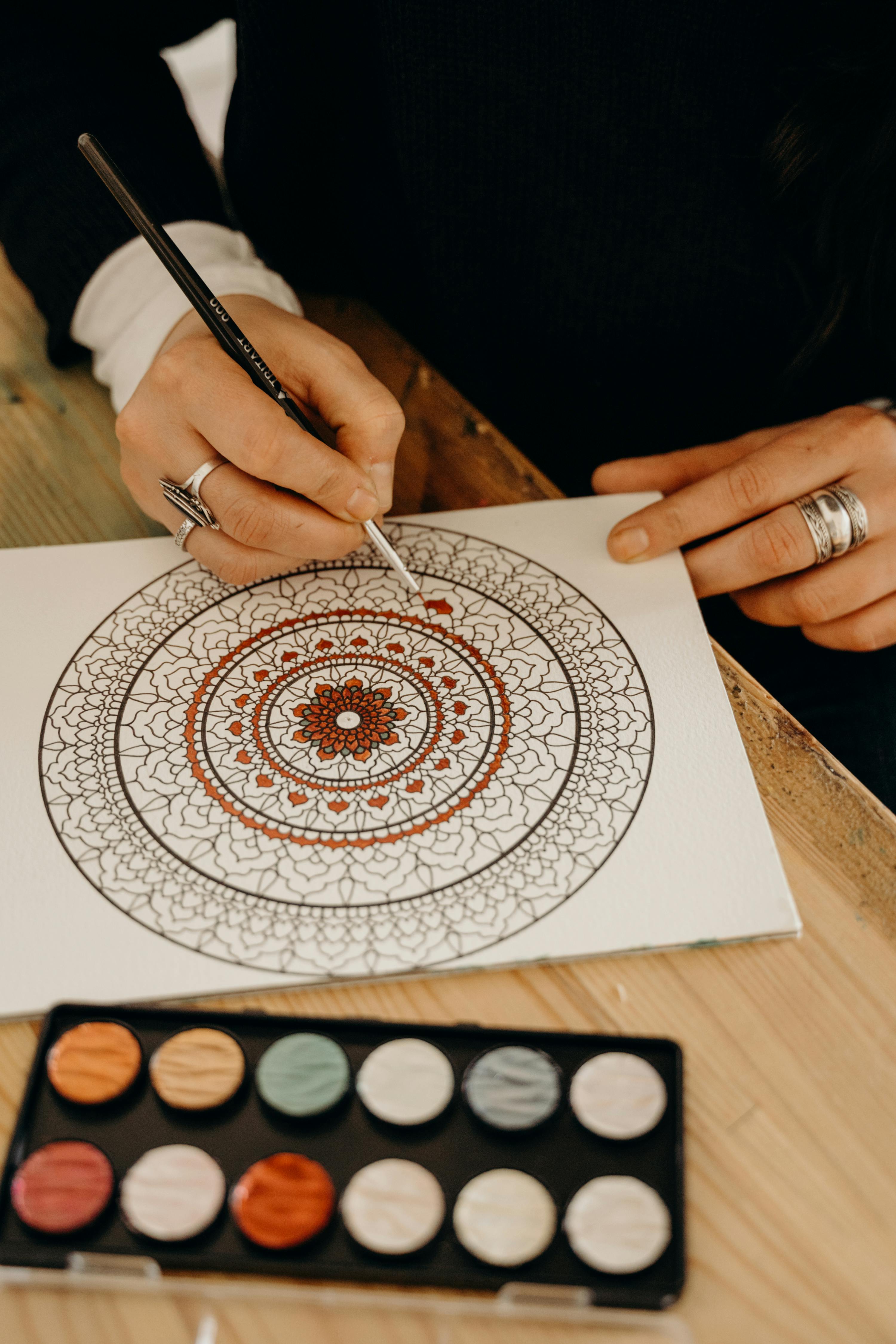
Starting at a single dot, hands move slowly through measured lines. From that middle point, shapes grow - each one built by quiet focus and steady rhythm. Patterns unfold step by step, guided less by chance than by deep-rooted form. The path spirals out, like thoughts moving from stillness into motion. What begins small becomes wide - not by force but by repetition.
Modern mandala artists may:
Draw freehand or use compasses and rulers.
Work digitally with design software.
Start with paint if you like bright colors. When lines matter most, try using ink instead. Carving works when depth feels necessary. Mixing different materials can happen after experimenting a while.
Focused on purpose, no matter the approach taken.
Mandalas in the Modern World
From glass to code, today's mandala makers reshape ancient symbols in fresh ways. Not bound by ritual, these designs mix heritage patterns with bold geometry. Color choices follow instinct more than rules, guided by now rather than then. Some pieces grow from tablets, others from hand-cut paper, each path different. Tradition bends here without breaking, finding room alongside spontaneity. What was once fixed now shifts, breathes, adapts - quietly.
These days, life moves quick. Yet inside that rush, drawing mandalas quietly stands out. Take coloring them - it slips into daily moments, calms nerves, sharpens attention. A quiet habit, really, but it holds space.
Mandalas in Interior Design and Fashion:
Home décor
Textiles and tapestries
Yoga studios
Fashion and accessories
Balance comes through their mirrored forms, where meaning shapes a quiet sense of order. Out of pixels, new patterns emerge. Some creators set their work in motion through animated sequences. Code steps in, building shapes that shift on their own. Touch can change the form, making viewers part of the piece. Old meanings travel forward, carried inside glowing circles.
Finding Your Connection
A shape might echo a memory you almost forgot. Though old meanings exist, your mind shapes what matters here. Look at the lines. Maybe they twist like something familiar. Colors could stir feelings not named before. Each loop may carry weight only you know. Think about where your eyes rest longest. Patterns sometimes whisper truths louder than symbols do.
Your emotional response
Where your eyes naturally focus
The colors or symbols that resonate most
A shape might speak before thought does. Understanding arrives without needing words.
Final Thoughts
Still here, mandala art thrives by reflecting harmony, connection, deep thought. Not just patterns - windows into calm, structure, personal journey. Through culture, belief, mind study, visual form, it holds steady ground. Each look reveals layers meant to resonate differently. Meaning shifts, yet presence remains fixed.
Starting with curiosity about mandala art meaning, moving through personal exploration of symbols, or diving into making them by hand - each path leads inward. This old practice still holds space for deep looking and change. The journey shapes the outcome.
A shape can hold meaning deeper than lines might suggest. Sometimes quiet patterns speak to inner balance without words. These circles carry wisdom grown from old roots but still changing today. People keep finding new ways to connect through them across distant places. From stillness comes pattern. Mandalas show how purpose grows from a single point, spreading slowly into shape. Meaning does not shout. It moves quietly through lines that loop back on themselves. A quiet pull draws the eye inward first, then guides it beyond. Centered things carry weight without effort. What starts small can fill every edge without rushing.